
Repression, Capitalism, Youth; Diciannove
(In relation-intrusive thoughts) (quick 1 hour write)
June 13th 2026
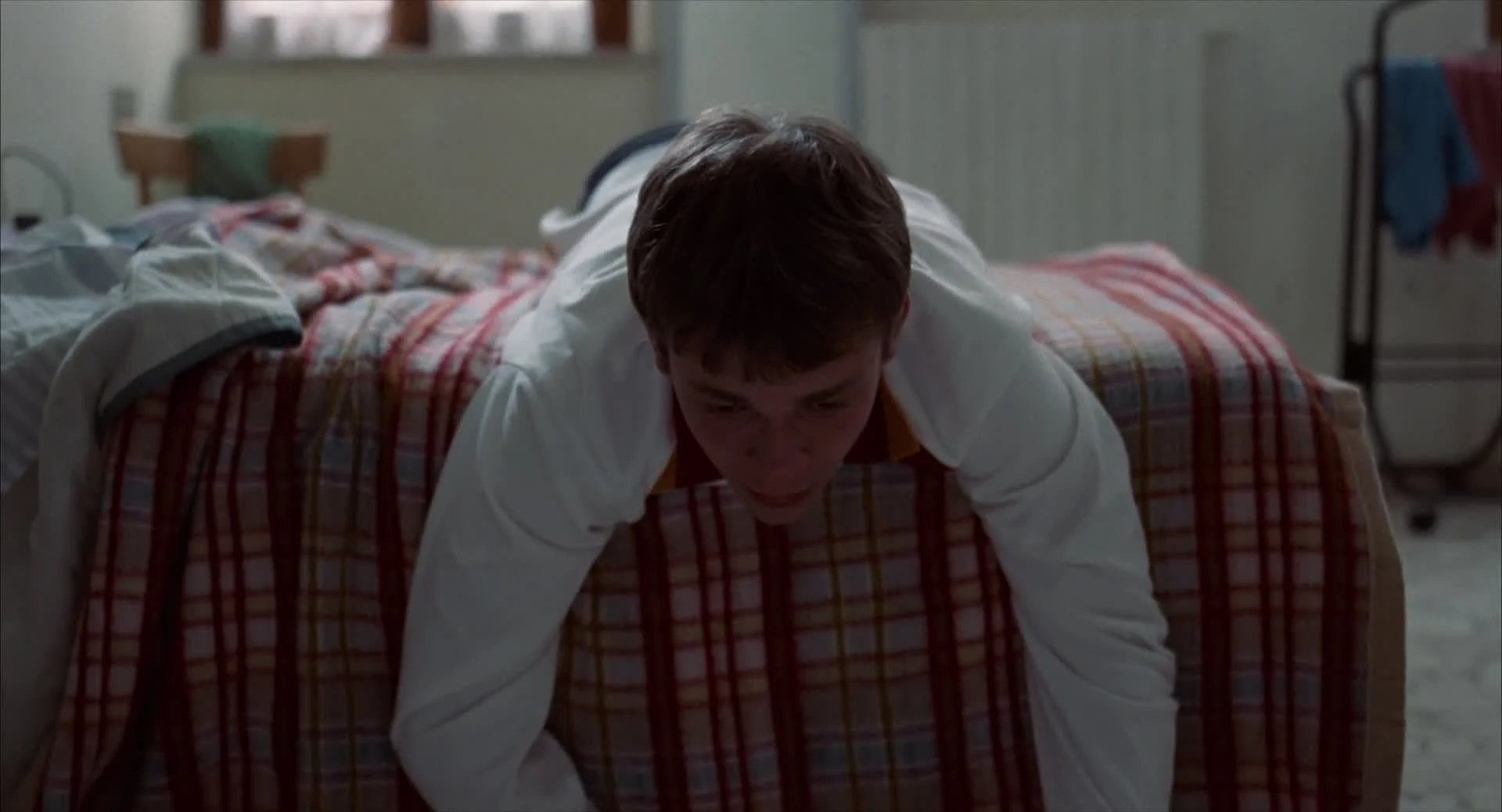
Nosebleeds seem to be signs of changing times. For me, my sibling first started having them when his health began deteriorating. A friend of mine also started having them before leaving the home of his adoptive parents, who had rescued him from a war torn country. As he grew older, the love that once held everything together seemed to fade, and everything in his life was changing. That is what is happening on the morning of Leonardo's life as he was having a nose bleed. A wave goodbye to it all. Diciannove by director Giovanni Tortorici means nineteen in Italian, an age caught between a push through a door where growth lies on the other side and a fear of the unknown waiting behind it (Western Means). In Leonardo's eyes flows a melancholy that expresses both excitement and sadness and also the growing pains of youth, but mostly the pains of a confused mind. One that I cannot blame. When I was sixteen turning seventeen, I moved to New York City alone. It was extremely difficult. I felt as though the world was ending. I had set my mind on something for so long that, once I arrived, I felt paralyzed. I had been thrown into a world so vast and intricate, far beyond anything I had ever known, that my brain could not process everything at once. Everything I loved seemed lost. That is what I saw in Leonardo's eyes as his mother drove him to the airport. His passions fading, his excitement fading too. The realization that the day had finally arrived for freedom. Freedom from the curfews, rules, and parental expectations that youth so often dream of escaping. Yet alongside that freedom came another realization that he now had to stretch, disperse, and become someone new. The fright comes from becoming both plural and singular at the same time. An uncanny feeling. A familiar phantasy, yet now collides with reality differently. Leonardo follows his sister to London to study what she was studying, business. On one hand, it is the illusion of an easier path. On the other, it is familiar. Familiarity can often disguise itself as certainty. We live in a society that exudes capitalism from every corner. Young people are encouraged to pursue disciplines that promise stability and income, while the humanities are treated as luxuries. I would object if we lived in another kind of society, but increasingly it feels as though the same economic reality has spread everywhere, even when disguised under different names. I am no nihilist, I promise. Yet the personality of capitalism remains the same no matter where it travels. Freud's theories within psychoanalysis can be applied to Leonardo's repressive tendencies, whether they concern queer desire or the confusion surrounding his sexuality. Especially when he is turned on by a public masturbator. He suppresses these feelings until they become buried beneath consciousness forming into unconscious repression, only to return through unexpected forms. That is what had happened to Leonardo. One hopes it is an endeavor of creative work (Can’t promise these days as we are all stuck in a loop of no time to die, but pay the bills). He channels it into something more forgiving and that is literature. Returning to Italy and enrolling in a prestigious university becomes more than an educational decision. It becomes a search for meaning. The same force that pushes him toward self sabotage also pushes him toward books, language, and ideas. But again he couldn’t fully satisfy the repression because of structured lectures that he had no interest in. Although Freud does not provide a complete answer for how hidden desires should be brought into consciousness (as his scientific studies were always evolving), he understood that repression seeks expression. When Leonardo sat through lectures that seemed to serve no purpose, I understood him. I enjoy having a text explained, but I do not want a professor replacing my thoughts with their own when interpreting a piece of writing. Leonardo begins to feel bored and unsatisfied. He becomes neurotic, obsessively reading dense books in his small room and caging himself within these four walls, which also serves as a kitchen and study space. This teaching method in institutions today reminds me of how Foucault challenged the idea that modern society simply represses desire. Instead, he argued that people are trained to seek confession of what is hidden because of the structures produced by modern power. Through these confessions, institutions begin to classify, categorize, and manage individuals. Leonardo seemed unconsciously aware of these dynamics, or at least that is how I saw it. He continued buying stacks of books even as boredom devoured his senses and the cost of those books consumed large portions of the allowance his mother gave him. In a way, his desire to study at an institution he had long fantasized about, particularly for its renowned literature department, ended in disappointment, leaving him unsatisfied in what Freud might call a failure of libido fulfillment. This drove him into a period of neurosis, once again marked by obsessive self teaching. Yet in Lacanian theory; the time he devoted to this new creative outlet, it gradually became a sanctuary for healing for it became a creative outlet that completely satisfied his unconscious desires, kind of resolving the tensions that were blocking him from maturing. Back in my socialist, neighborhood in Yemen, books circulated freely. People handed them out in stacks. Reading felt communal. Today, buying a single book can cost a day's wages. As Robespierre exclaimed, "La république ? La monarchie ? Je ne connais que la question sociale." ("The republic? The monarchy? I know only the social question.") His point was simple: debates over political forms matter little when ordinary people remain burdened by material hardships that bluntly suck the life out of them. The question of how people live has always mattered more than the labels attached to governments. Watching Leonardo slowly assemble himself throughout Diciannove, I was reminded that youth is not simply a period of growth. It is also a period of mourning. We mourn old versions of ourselves while attempting to create new ones. Leonardo's journey is not about arriving at certainty. It is about learning to tolerate uncertainty long enough to discover who he might become in this reality surrounding him.